

First Linenbacking Attempt

After reading the posts on this forum 3-4 times and after watching as many old videos I could find, I took the plunge. I moved from paperbacking to linebacking. While I'm still very much in the learning process, my experience with paperbacking helped my avoid a number of potential linenbacking errors.
First, as others have done, I made a canvas mounting frame large enough to work on and around a one-sheet movie poster.
Next, I watched Charlie video showing him attach cotton duct to his frame. The only proble I had with this was AFTER completion. I'm not sure how to remove one-inch deep staples from the frame without tearing large chunks out of the frame. Maybe I should consider hand-stapling with less deep staples. the ones I used drove approx. 1" into the 2x4 frame. Short staples? Use a hand stand stapler?
Regardless, I followed the same procedure used to papermount the Stanwyck "Man Killer" 1/2 sheet. First I sprayed the mounted canvas a few times with distilled water to create some expansion of the canvas fiber before mounting Mulberry and the poster. Next, I placed the Mulberry on Mylar and wet it down. I tried to create a smooth Mulberry surface on the Mylar BEFORE wheat pasting the Mulberry to the cotton duct.
After applying a liberal coat of wheat paste onto the cotton duct, I applied the Mylar/ Mulberry pack onto the wheat paste. Prior to application, I used distilled water to respray the wheat paste.
Here's a pic of the mounted Mulberry (52-gsm "thick roll" from Talas):
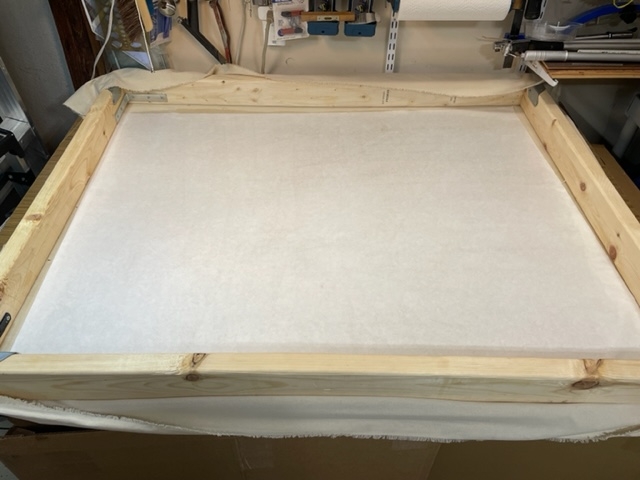
While I tried to work out air pockets and paper wrinkles while the Mulberry was on the Mylar, I couldn't get all the wrinkles out. There weren't many but I could see them. I used a bondo squeegee to work out the air pockets, wrinkles working and excess wheat paste from the inside (middle) of the poster to the outside of the poster.
Here's a close up of a crease:
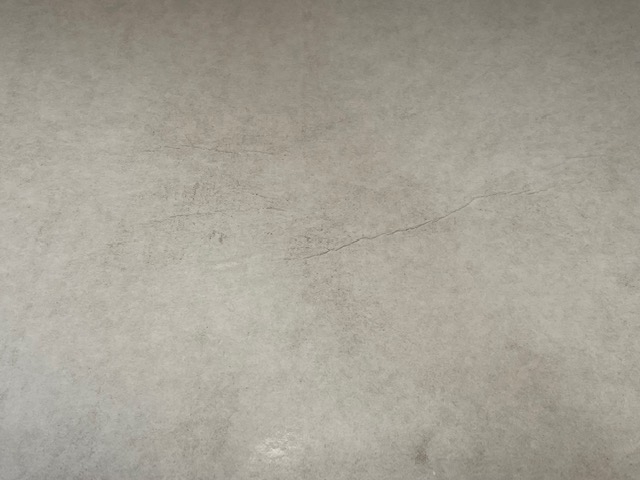
After mounting the Mulberry, I used the same process to mount the poster. I tried to relax the folds by spraying with distilled water while the poster was on the Mylar. I lifted and re-lifted the wet poster a few time to get it to lie flat on the Mylar. I used my hands and a squeegee to remove as many air pockets as I could. This ended up creating what I found to be at least one permanent wrinkle.
NOTE: I used a $1.25 poster for this exercise. It didn't need deacidification or bleaching because all I was interested in was the mounting technique and experience. That said, if other would like to chime in to share their thought on how I can improve, especially in removing the air pockets and wrinkles prior to mounting the poster to the canvas, all comments are welcome!
Here's the mounted poster (I placed the Mylar on the canvas, rolled the poster side onto the Mulberry off the Mylar):
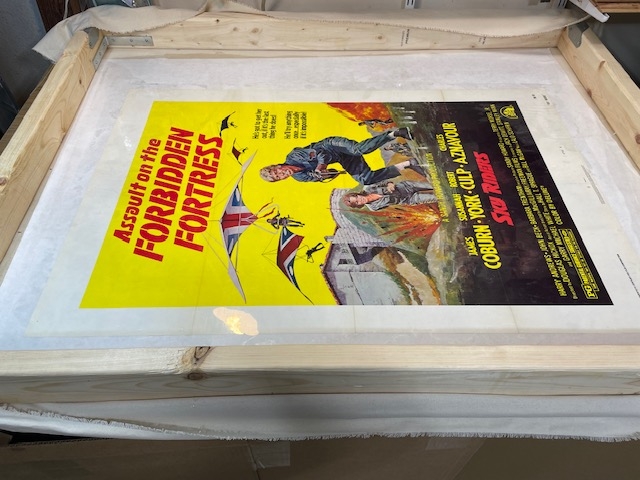
Small creases:
First, as others have done, I made a canvas mounting frame large enough to work on and around a one-sheet movie poster.
Next, I watched Charlie video showing him attach cotton duct to his frame. The only proble I had with this was AFTER completion. I'm not sure how to remove one-inch deep staples from the frame without tearing large chunks out of the frame. Maybe I should consider hand-stapling with less deep staples. the ones I used drove approx. 1" into the 2x4 frame. Short staples? Use a hand stand stapler?
Regardless, I followed the same procedure used to papermount the Stanwyck "Man Killer" 1/2 sheet. First I sprayed the mounted canvas a few times with distilled water to create some expansion of the canvas fiber before mounting Mulberry and the poster. Next, I placed the Mulberry on Mylar and wet it down. I tried to create a smooth Mulberry surface on the Mylar BEFORE wheat pasting the Mulberry to the cotton duct.
After applying a liberal coat of wheat paste onto the cotton duct, I applied the Mylar/ Mulberry pack onto the wheat paste. Prior to application, I used distilled water to respray the wheat paste.
Here's a pic of the mounted Mulberry (52-gsm "thick roll" from Talas):
While I tried to work out air pockets and paper wrinkles while the Mulberry was on the Mylar, I couldn't get all the wrinkles out. There weren't many but I could see them. I used a bondo squeegee to work out the air pockets, wrinkles working and excess wheat paste from the inside (middle) of the poster to the outside of the poster.
Here's a close up of a crease:
After mounting the Mulberry, I used the same process to mount the poster. I tried to relax the folds by spraying with distilled water while the poster was on the Mylar. I lifted and re-lifted the wet poster a few time to get it to lie flat on the Mylar. I used my hands and a squeegee to remove as many air pockets as I could. This ended up creating what I found to be at least one permanent wrinkle.
NOTE: I used a $1.25 poster for this exercise. It didn't need deacidification or bleaching because all I was interested in was the mounting technique and experience. That said, if other would like to chime in to share their thought on how I can improve, especially in removing the air pockets and wrinkles prior to mounting the poster to the canvas, all comments are welcome!
Here's the mounted poster (I placed the Mylar on the canvas, rolled the poster side onto the Mulberry off the Mylar):
Small creases:
0
Get In Touch

Comments
The creases are very hard to see but I'm shooting for NO creases (if possible).
Ready for clean up:
I had bad results using a sponge to clean up excess wheat paste prior to this. This time, while avoiding using the sponge on the printed area, I found it easier to use the sponge to clean up excess wheat paste from the edges of the poster. Too heavy of a sponge hand will also damage the wet Mulberry as well. You can see an area of Mulberry where I pressed too hard. Fortunately, it was well off the poster and closer to the mounting frame.
After cleaning up the poster, I let everything dry for two days.
Drying:
Cut from the frame:
Finished trim (1/2" border):
All and all, considering it's my first attempt, I'm satisficed with the results. I need to improve my handling and mounting technique to eliminate wrinkles and self-imposed creases. Since it's an el cheapo poster, I'm not going to work on touch-up.
Generally, I found reading everything on this site a number of times is the best first step. Gaining some experience by paperbacking cheap, smaller posters and lobby cards prior to linenbacking a one-sheet helped me. Finding and watching videos here and on the web also provided good insight into the process as well.
I'd like to thank Charlie, Mark/ Eisenhower and all the others for providing their experience and what they've learned. REALLY couldn't have gotten this far without their help!
Again, feel free to chime in with comments!
https://www.talasonline.com/Teflon-Folders